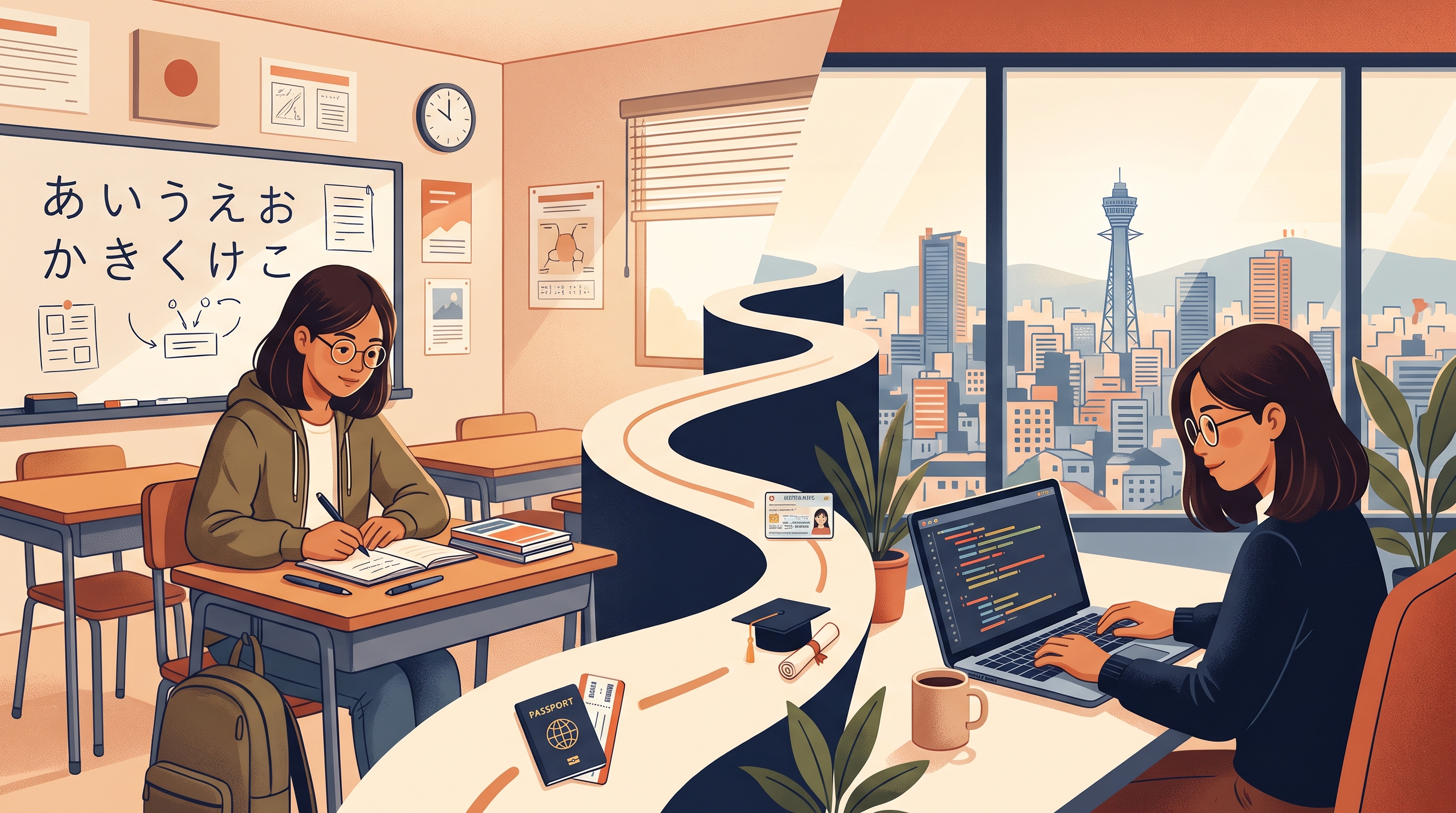
I arrived in Japan from Indonesia in October 2016 with a student visa and very basic Japanese. Four years later, I switched to a work visa and started as a backend developer. Six years after that, I'm still here, writing system design documents in Japanese and maintaining a production system used across hundreds of locations in Japan.
A lot of people message me asking how that switch works. This is the honest version: my timeline, the actual visa process, and the mistakes worth avoiding.
- A language school alone does not qualify you for an engineering work visa. You usually need a university degree or a Japanese vocational school diploma related to the job.
- You apply for a Change of Status of Residence at immigration after you get a job offer, and before your student visa expires.
- You can't start full-time work until the change is approved.
- Japanese ability (JLPT N2 or higher) makes the job hunt much easier, even for developer roles.
My timeline
| When | Status | What I was doing |
|---|---|---|
| Oct 2016 | Student visa | Arrived in Japan, started language school |
| 2016–2018 | Student visa | Japanese language school (1.5 years) |
| 2018–2020 | Student visa | Junior college / 短期大学 (2 years) |
| Aug 2019 (2nd year of college) | Student visa | Got a job offer through a job fair |
| Oct 2020 | Engineer / Specialist in Humanities visa | Started as a backend developer |
| Now | Same visa, 5-year period | Still developing — now also writing design specs |
Step 1: Language school is the start, not the qualification
I spent a year and a half in language school before moving on to college. Language school gave me two things: Japanese, and time to understand how life and work in Japan actually function. It does not count as the educational background immigration looks for when you apply for a work visa.
On a student visa you can work part-time, but only with a work permission (資格外活動許可) and generally up to 28 hours a week during the school term.
I worked part-time at a bento factory during language school. It was tiring after a full day of class, but working alongside Japanese colleagues — with no English as a fallback — pushed my listening and speaking faster than any classroom exercise. When I moved to college, I switched to delivery work at Yamato Transport (ヤマト運輸) and also worked shifts at a supermarket. Both jobs contributed more to my daily Japanese than I expected.
During language school I sat the JLPT and passed N3. I then passed N2 in my first year of college. In my experience, N2 was the level where Japanese companies started taking my applications seriously.
Step 2: Check you meet the visa requirements before job hunting
The visa most developers get is Engineer / Specialist in Humanities / International Services (技術・人文知識・国際業務). In general, immigration wants to see one of these:
- A university degree (from Japan or abroad) related to the job, or
- A degree from a Japanese junior college (短期大学) or vocational school (専門学校) in a related field, or
- Many years of relevant work experience (typically 10 years for engineering roles)
The job itself also has to match your background. A developer job needs an IT or related education — not a degree in an unrelated field with no connection to the work.
That's why I didn't go straight from language school into job hunting. After language school, I enrolled in a junior college (短期大学) in Japan for two years — my major was 経営情報学科 デザインアートコース (Business Information / Design Art). The important thing is that I also took IT subjects within that curriculum, which is what immigration looks at: whether your coursework is actually connected to the job you're applying for.
Step 3: Job hunting as a student
I found my job through a job fair I attended while I was in college. Around August of my second year, I already had an offer. That meant I could spend the rest of my final year finishing school instead of worrying about whether I'd have a job after graduation.
A few things I learned from that:
- Job fairs are underrated for international students. You meet companies face to face, and many of them are there specifically because they're open to hiring foreigners.
- Start early. In Japan, companies hire students well before graduation. If you wait until your last few months, many positions are already filled.
- Your school matters. Colleges and vocational schools often have career support and connections with companies that language schools don't.
My interview at the fair was conducted in Japanese. The questions were typical: why do you want to join this company, what experience do you have, what can you contribute. For the IT experience part, I talked about building a website when I was in vocational high school back in Indonesia, the programming I studied there, and the web development I continued in college. It was not an impressive portfolio by professional standards, but it showed I had been building things consistently — not just studying theory.
Step 4: Changing your status of residence
Once you have a job offer, you apply for a Change of Status of Residence (在留資格変更許可申請) at your regional Immigration Services Bureau. The company and you prepare the documents together. Typically you'll need:
- The application form and a photo
- Your passport and residence card
- Your diploma and transcript
- Your employment contract or a document showing your job, salary, and duties
- Documents about the company (what's required depends on the company's size category)
Processing usually takes from a few weeks to a couple of months. When it's approved, you receive a notice, pay the fee with a revenue stamp, and get a new residence card showing your new status. Check the Immigration Services Agency website for the current fee and document list, as these change.
My application took roughly one to two months to process. The company handled most of the paperwork on their end, and I submitted my documents through the immigration office. By the time October came, everything was approved and I started work on schedule.
Step 5: Renewals and longer visa periods
Your first work visa may be granted for 1, 3, or 5 years. Each renewal is a chance to get a longer period. Stable employment, paying taxes and pension on time, and reporting changes properly all help.
My student visa went through several renewals during my time in school: 1 year, then a 6-month extension, then 1 year, then another 1 year. For the work visa, my first period was 1 year, then I renewed to 5 years, and I'm now on my second 5-year period.
If you change jobs later, you must notify immigration within 14 days. As long as the new job fits your visa category, you can usually keep the same visa until your next renewal.
What I'd do differently
1. Study Japanese seriously in my own time — not just attend class.
Language school gives you structure, but it doesn't carry you across the finish line by itself. I assumed showing up to class every day was enough. It wasn't. The students who progressed faster were the ones who went home and studied an extra hour or two on top of class. If I had treated JLPT prep as a personal goal from month one — not just as something school would eventually prepare me for — I would have reached N2 sooner and had more options earlier.
2. Research the visa requirements in detail before choosing a college.
I knew I needed to go to college after language school, but I didn't fully understand the rule that your major has to be connected to your future job. My major was Design Art (デザインアートコース) under a Business Information department — not obviously IT. What saved me was that I took IT-related subjects within that curriculum, so immigration approved my visa. But I only found this out after the fact. If I had known earlier, I would have made sure to pick those subjects deliberately — or chosen a more directly IT-focused program from the start. If your major and your job have no connection at all, the visa can be rejected regardless of your skills.
3. Start building something — anything — from the beginning.
At my job fair interview, the only technical experience I could talk about was building a basic website in high school and the web projects from college. That was enough to get the offer, but I was lucky. If I had spent even a few hours a week during language school working on small projects, I would have had much more to show. You don't need a polished portfolio — you need evidence that you were building things on your own, not just following a curriculum.
Tips if you're from Indonesia
- Get your documents in order early. Diplomas and transcripts from Indonesia may need translations. Keep originals and copies.
- Aim for N2 before you graduate. It opens far more doors than N3.
- Pay your taxes and pension on time from day one. It matters for every renewal, and later for permanent residency.
- Use the Indonesian community. Seniors who already made the switch are the best source of real, current information.
FAQ
Q: Can I work full-time on a student visa?
No. Part-time work is limited to 28 hours per week during term (resource: 資格外活動許可), and full-time work requires the work visa to be approved first.
Q: Do I need JLPT to get an engineer visa?
Immigration doesn't require it, but most Japanese companies do in practice. English-only companies exist, but they're more competitive. Aim for N2 before starting your job hunt.
Q: Can a language school diploma qualify me for a work visa?
Generally no. You need a related university degree, a Japanese junior college degree (短期大学) or vocational school diploma (専門士), or long relevant work experience — typically 10 years for engineering roles.
Q: Can I change jobs on an engineer visa?
Yes, if the new job fits the same category. Report the change to immigration within 14 days of starting at the new company.
This article is based on my own experience and general information about Japan's visa system. Rules change, so always check the latest requirements with the Immigration Services Agency of Japan or a licensed visa specialist (行政書士).