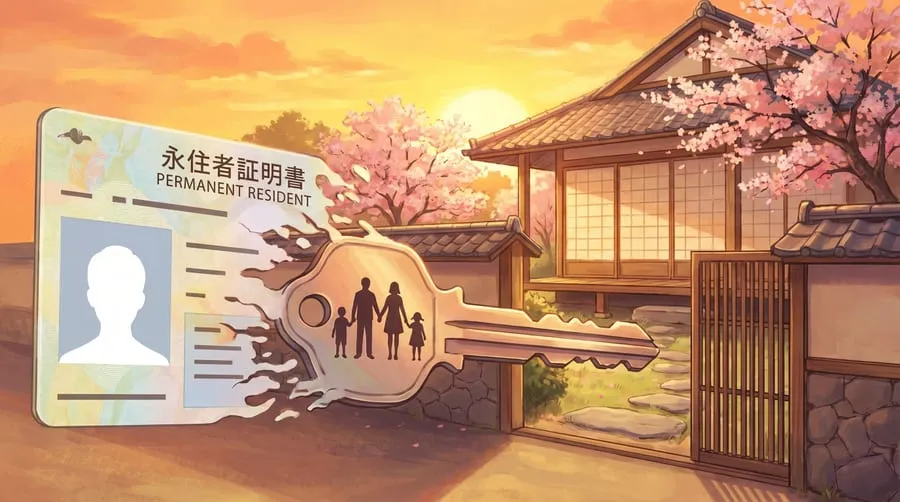
Most people assume that getting permanent residency (PR) in Japan means waiting 10 years. That's true for the standard path — but it's not the only path. Software developers and IT engineers have access to a fast-track route through the Highly Skilled Professional (HSP) visa that can cut that timeline down to 1–3 years. This guide covers both paths, the full points calculation, and exactly what you need to prepare your application.
Two Paths to Japan Permanent Residency
Japan's Immigration Services Agency (入管庁) offers two main routes to permanent residency for working professionals:
10-Year Residency
Live and work in Japan continuously for 10 years on any work visa (Engineering, Gijinkoku, etc.). Tax payments, no criminal record, and a stable income are required. Straightforward but slow.
HSP Visa PR (1–3 Years)
Hold the Highly Skilled Professional (高度専門職) visa and accumulate a points score. 70+ points → PR eligibility after 3 years. 80+ points → PR eligibility after just 1 year.
For most IT engineers in Japan, the HSP route is the faster and more practical option. The rest of this article focuses on it in detail.
What Is the Highly Skilled Professional (HSP) Visa?
The 高度専門職ビザ (kōdo senmon shoku biza) is Japan's points-based visa for skilled foreign professionals. It was introduced to attract global talent and comes with significant advantages over the standard Engineering visa:
- Multiple activity permission — you can do side work and consulting without a separate visa
- Longer residence period — 5-year status instead of the standard 1–3 years
- Spouse work rights — your spouse gets work authorization, regardless of their job
- Bring parents — in some conditions, you can sponsor a parent's visit for childcare
- Fast PR track — the headline benefit: PR in 1–3 years instead of 10
The HSP visa has two types relevant to IT engineers: HSP-i (1-i) for advanced academic/research roles and HSP-ii (1-ii) for professional/technical work. Most software engineers fall under HSP-ii. There's also HSP-iii for business management, but that's a different category.
The HSP Points System: Full Breakdown
Your HSP score is calculated across three categories: academic background, professional experience, and salary. You need a minimum of 70 points to qualify for the HSP visa. Points from a fourth "bonus" category can push you over the threshold or help you reach 80+.
| Category | Criterion | Points |
|---|---|---|
| Academic Background | ||
| Degree | Doctorate (PhD) | 30 |
| Master's degree | 20 | |
| Bachelor's degree | 10 | |
| Two or more degrees (e.g. dual Bachelor's) | +5 bonus | |
| Professional Experience | ||
| Years in the field | 10+ years | 20 |
| 7–9 years | 15 | |
| 5–6 years | 10 | |
| 3–4 years | 5 | |
| Annual Salary (gross, in JPY) | ||
| Salary | ¥10,000,000+ | 40 |
| ¥9,000,000–9,999,999 | 35 | |
| ¥8,000,000–8,999,999 | 30 | |
| ¥7,000,000–7,999,999 | 25 | |
| ¥6,000,000–6,999,999 | 20 | |
| ¥5,000,000–5,999,999 | 15 | |
| ¥4,000,000–4,999,999 | 10 | |
| Bonus Points | ||
| Japanese language | JLPT N1 (or JPT 800+) | 15 |
| JLPT N2 (or JPT 600+) | 10 | |
| Qualifications | Relevant national qualification (IT Passport, Applied Information Technology Engineer, etc.) | 5 |
| Employer | Employed by a company designated as an innovation-promoting company by the Japanese government | 10 |
| Research | Published research, patent, government-funded project participation | varies |
| Graduate of Japanese university | Studied at a Japanese university or graduate school | 10 |
| Age | Under 30 | 15 |
| 30–34 | 10 | |
| 35–39 | 5 | |
The official calculator is on the Immigration Services Agency (MOJ) website. Run your numbers there for the official result.
What a Typical Developer Score Looks Like
Here's a realistic example for a mid-level backend developer in Japan:
Example: Mid-level backend engineer, 5 years experience, age 29
At 70 points, this engineer qualifies for the HSP visa and can apply for permanent residency after 3 years in that status. To reach 80+ (for the 1-year PR track), they'd need a salary raise to ¥7M+ (adds 5 pts) or pass JLPT N1 (worth 15 pts over N2).
The age bonus is the most underused category. If you're under 30 and planning to move to Japan, doing it now instead of in your mid-30s is worth a clean 10–15 bonus points. Those points can be the difference between a 3-year and 10-year path to PR — or between qualifying for HSP at all.
How to Switch to the HSP Visa (If You're Already in Japan)
If you're currently on an Engineering/Humanities/International Services visa (技術・人文知識・国際業務) and your points score meets the 70-point threshold, you can change your status to HSP-ii without leaving Japan. This is called a 在留資格変更許可申請 (status of residence change application).
The process:
-
Calculate your points and gather evidence
Use the official MOJ calculator. For each point category you claim, you need a supporting document: degree certificate, employment contract, recent tax return (源泉徴収票), JLPT certificate, etc.
-
Download the HSP application forms
From the Immigration Services Agency website. You'll need: the status change form, the points calculation sheet (様式1), and individual point evidence sheets (様式2).
-
Prepare your document package
Required documents include: passport + residence card, recent tax certificate (課税証明書) and tax payment certificate (納税証明書) from your city hall, employment contract or company letter, degree certificate (officially translated if not in Japanese or English), recent pay slips (3 months).
-
Submit at your regional Immigration Services Bureau
You can submit in person at your nearest immigration office, or apply online via the Immigration e-Application system if your employer is registered. Processing takes 1–3 months.
-
Receive your new HSP residence card
Once approved, your new card shows 高度専門職1号ロ (HSP type 1-ii). The 5-year validity starts from the issue date. Your PR eligibility clock starts from this date (or retroactively from when you first qualified, in some cases — confirm this with an immigration lawyer).
Applying for Permanent Residency
Once you've held HSP status for 1 year (80+ points) or 3 years (70–79 points) and meet the general requirements below, you can apply for permanent residency (永住許可申請).
General PR requirements
- Tax compliance — All income taxes and social insurance (健康保険, 厚生年金) must be fully paid. Outstanding payments are the most common reason applications are rejected.
- Clean record — No criminal history or immigration violations. Traffic violations are generally overlooked; serious offenses are not.
- Stable income — No strict minimum, but immigration wants to see you can support yourself independently. A regular salary with pay slips showing consistent income is ideal.
- Intention to reside permanently — You should be genuinely settled in Japan: stable housing, local ties, utility accounts in your name.
Documents for the PR application
- 永住許可申請書 (permanent residency application form)
- 理由書 (reason for applying — write this in Japanese, or have a professional write it)
- Passport + current zairyu card
- 住民票 (juminhyo — residence certificate from city hall)
- Source of income certificate (在職証明書) + salary slips (3 months)
- Tax and social insurance payment certificates (3 years of records)
- HSP points calculation sheet + supporting evidence (same docs as your HSP application)
- Guarantor letter (身元保証書) from a Japanese national or permanent resident who will vouch for you
Missing or late tax/pension payments are the #1 reason PR applications are rejected. Even a single missed month of pension contributions can trigger a rejection. Starting from your first day in Japan, pay everything on time — health insurance, pension, and income tax. If you've missed any, pay immediately and get a payment record certificate from your ward office.
Practical Tips to Maximize Your Points and Speed Up PR
1. Negotiate your salary with PR in mind
The biggest lever in your points score is salary. Going from ¥5.5M to ¥6.0M is just a cost-of-living raise; going from ¥5.9M to ¥6.0M earns you 5 extra points. Know the thresholds (¥4M, ¥5M, ¥6M, ¥7M, ¥8M, ¥9M, ¥10M) and negotiate to clear the next one. See our IT salary guide for benchmarks by role and experience level.
2. Get the Applied Information Technology Engineer exam
The 応用情報技術者試験 (Applied IT Engineer) is a Japanese national IT qualification worth 5 bonus points. It has a Japanese-language exam, but there's an English-translated past exam available for practice. Paired with JLPT N2, that's 15 bonus points from qualifications alone. See our guide on Japanese for engineers for study strategy that combines both goals.
3. Track your HSP start date carefully
Your 1-year or 3-year PR eligibility clock starts from the date your HSP status was granted — not when you applied. Get this date from your residence card and mark it clearly. Many people miss early PR windows by not knowing the exact date.
4. Hire an administrative scrivener (行政書士) for the application
Immigration applications in Japan are in Japanese and the requirements are strict. A gyoseishoshi (行政書士) — a licensed administrative scrivener who handles immigration matters — can prepare your documents correctly and write your 理由書 (reason letter) in proper Japanese. Fees are typically ¥80,000–150,000, but they significantly reduce the risk of rejection.
5. Don't change jobs just before applying
Immigration checks employment continuity. Job-hopping is normal in tech, but switching employers in the 6 months before you apply for PR can raise questions. If you're close to your PR application date, time your job change carefully — or wait until after PR is approved.
Life After Permanent Residency: What Actually Changes
Getting Japan PR is a significant milestone. Here's what concretely changes:
- No more visa renewal stress — Your PR card is valid for 7 years (renewed at city hall, not immigration). No more sponsor dependency, no more annual renewals.
- Work freely — Change jobs, go freelance, start a company, work any industry — no immigration restrictions.
- Better mortgage rates — PR holders can access Japanese home loans (住宅ローン) from major banks, including flat-rate products like Flat 35.
- Stronger apartment applications — Some landlords who rejected you before as a foreigner will accept PR holders without issue.
- Path to naturalization — After PR, you can apply for Japanese citizenship (naturalization) after 5 years of total residence. PR itself does not give you citizenship.
- Still need to renew your address — PR doesn't mean you're a citizen. You still have a residence card and must notify the city hall when you move. If you leave Japan for more than 1 year without a re-entry permit, you can lose PR status.
"I got PR at the 3-year mark on HSP. The biggest change wasn't the immigration office — it was the mental load. Not having to think about visa renewal every year, not worrying when looking for a new job. That feeling is underrated."
Your PR Prep Checklist
- Calculate your HSP points score using the official MOJ calculator
- If 70+ points: apply to change status to HSP-ii at your regional immigration office
- Note your HSP approval date — this starts your PR eligibility clock
- Set up auto-pay for health insurance and pension (never miss a payment)
- Request a tax payment certificate (納税証明書) from your city hall each year
- Consider JLPT N2 or N1 if you need more bonus points
- Consider the Applied IT Engineer exam (応用情報技術者試験) for 5 bonus points
- Find a gyoseishoshi (行政書士) 6 months before your PR target date
- Gather 3 years of tax certificates, pay slips, and employment records
- Find a Japanese national or PR holder willing to be your guarantor (身元保証人)
- Write your 理由書 (reason for applying) — have it reviewed in Japanese
- Submit application and wait 4–6 months for a decision
The Ministry of Justice publishes the official HSP points table and PR requirements on their website. Rules change periodically, so always cross-check with the official MOJ/ISA guidelines before submitting. This article reflects rules as of July 2026.