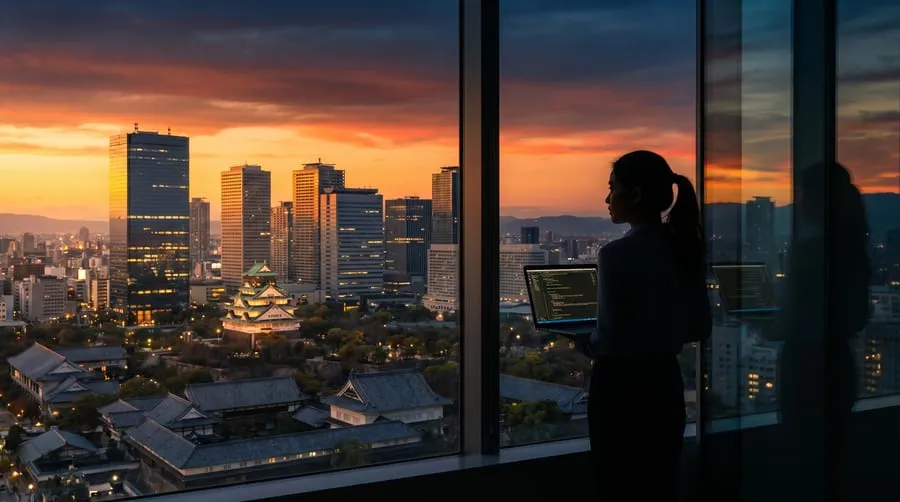
Most guides to working in Japan as a foreign engineer begin and end with Tokyo. That makes sense — Tokyo is the largest tech market in the country and home to the most English-friendly companies. But it is also one of the most expensive cities in Asia to live in, with some of the longest commutes in the world and a pace of life that is not for everyone.
Japan has other options. Osaka has a real and growing tech scene with significantly lower costs. Fukuoka has government-backed startup support that has attracted international founders and engineers from across Asia. Nagoya is the place if your interests lean toward automotive and embedded systems. And remote work has increasingly decoupled the question of "which city has the best jobs" from "which city should I actually live in."
This guide compares Japan's major IT cities across the dimensions that matter for foreign engineers: salary levels, cost of living, the availability of English-friendly employers, the startup ecosystem, and the overall quality of life. By the end, you should have a clear framework for choosing the city that fits your specific goals — not just the default answer.
Tokyo — The Dominant Tech Hub
There is a reason every article on IT jobs in Japan defaults to Tokyo: the numbers support it. Tokyo has a concentration of English-first tech companies that no other Japanese city comes close to matching. Google Japan, Amazon Japan, Mercari, Stripe, Woven by Toyota, SmartNews, LINE Yahoo, freee, DeNA, GREE — all have major engineering operations in Tokyo. For a foreign engineer who does not speak Japanese, the probability of finding a well-paying role where English is the working language is significantly higher here than anywhere else in the country.
Salaries at these companies reflect that concentration of competition. Mid-level software engineers at top-tier Tokyo employers earn between ¥6M and ¥12M per year depending on specialization, level, and company. Senior engineers and staff-level roles regularly exceed ¥12M. The TokyoDev salary survey is the most reliable public benchmark for what foreign engineers actually earn in Japan — the Tokyo figures are consistently the highest in the country. For a full take-home breakdown by role and experience level, see our Japan IT salary guide.
Where tech offices cluster
Tokyo's tech scene is not evenly distributed across the city. The highest concentration of startup and tech company offices is in Shibuya, Shinjuku, and Roppongi — all well-connected by train but among the more expensive residential areas in the city. Many engineers choose to live slightly further out (Nakameguro, Shimokitazawa, Sangenjaya for Shibuya workers; Koenji or Nakano for Shinjuku workers) to manage rent at the cost of a longer commute.
The honest downsides
Tokyo is crowded in a way that takes adjustment. The rush-hour trains on the Yamanote Line and Chuo Line are a genuine quality-of-life cost — packed to capacity, with commutes of 40–70 minutes each way being entirely normal for engineers who live somewhere affordable. Central ward rent for a 1LDK apartment runs ¥100,000–200,000 per month, and that is before utilities, guarantor fees, or the lump-sum move-in costs that are standard in the Japanese rental market. For more on housing costs, see our guide to cost of living in Japan for IT engineers.
The pace of life in Tokyo — while energizing for some — can also be exhausting. Long hours remain a cultural norm at many Japanese companies (less so at international tech firms), and the city does not slow down in the way that Osaka or Fukuoka can feel like it does.
If you are new to Japan and want to maximize your career options and salary ceiling, Tokyo is almost always the right starting point. Build your Japanese-market track record at an English-first company for 2–3 years, then reassess whether the lifestyle cost is worth the salary premium — or whether remote work can give you both.
Osaka — Quality of Life Meets Real Career Options
I am going to be transparent here: I live in Osaka, and I chose it deliberately after spending time working in Tokyo. So take my perspective with that context — but also know that it comes from direct experience rather than secondhand research.
Osaka's tech scene is real and growing, even if it does not match Tokyo in scale. Rakuten has significant engineering operations in Osaka. NTT Data, NTT Communications, and Fujitsu all have substantial Osaka presences. There is a cluster of growing SaaS companies and B2B software firms in the Umeda and Namba districts, and the city's general business concentration means that in-house IT teams at major companies are numerous. The job board is smaller than Tokyo's, but it is not thin.
Salaries in Osaka run approximately 10–15% lower than equivalent Tokyo roles for the same job at the same company type. That gap matters less than it looks, however, when you factor in the cost of living difference. A ¥7M Osaka salary with ¥90,000/month rent leaves more in your pocket each month than an ¥8M Tokyo salary with ¥160,000/month rent — especially when you also factor in cheaper dining, shorter commutes, and generally lower day-to-day expenses.
Why Osaka works for foreign engineers
Osaka has a reputation — entirely deserved in my experience — for a more relaxed work culture than Tokyo. The city's commercial character is more merchant than corporate. Osakans tend to be direct, sociable, and less status-conscious than their Tokyo counterparts. For foreigners navigating a Japanese work environment, this often translates to a less rigid hierarchy, somewhat shorter hours at many companies, and more willingness to communicate informally.
The shinkansen connection to Tokyo (approximately 2.5 hours, ¥14,000 one-way on the Nozomi) is a genuine advantage for engineers who need occasional Tokyo in-person meetings. Several Osaka-based engineers I know maintain relationships with Tokyo clients or employers using a "once a month in Tokyo" approach that keeps them professionally connected without the full cost of Tokyo life. For travel and cost planning, see our cost of living guide which covers both cities.
Osaka works best for engineers with 3–5+ years of Japanese market experience who have already built their resume and network, and are now optimizing for sustainability. It also works well for engineers whose target companies have Osaka offices — check job listings at Rakuten, NTT, and major SaaS companies for Osaka-based roles specifically.
Fukuoka — Japan's Startup City
Fukuoka occupies a unique position in Japan's tech landscape. It is not a city that competes with Tokyo on raw job volume or salary — it competes on a different axis entirely: Fukuoka is the best city in Japan to start something.
In 2014, Fukuoka City was designated as a National Strategic Special Zone, and one of the programs that came from that designation was the Fukuoka Startup Visa — a program allowing foreign nationals to stay in Japan for up to 6 months while preparing to incorporate a business, without requiring a pre-existing company. This is genuinely rare in Japan's otherwise rigid visa system. For foreign founders looking to enter the Japanese market, Fukuoka has become the de facto entry point. See our IT work visa guide for details on the Startup Visa requirements and how it compares to other visa categories, and visit the official Fukuoka City Startup Visa page for current application details.
The cost of living advantage
Fukuoka's cost of living is the lowest of any major Japanese tech city. A central 1LDK apartment runs ¥50,000–90,000 per month — roughly half the cost of an equivalent Tokyo apartment. Dining out is noticeably cheaper. Commutes within the city are short. The city is compact and highly livable. For engineers whose primary motivation is not maximizing yen earned but maximizing quality of life per yen, Fukuoka makes a compelling case.
The honest trade-offs
Fukuoka's international community is smaller than Tokyo's or Osaka's. The number of large companies with English-as-a-working-language engineering teams is limited. Line (now Line Yahoo) has had Fukuoka operations, and there are several well-funded local startups with international ambitions — but if you are looking for the kind of dense English-friendly job market that Tokyo offers, Fukuoka will frustrate you. Japanese language ability becomes significantly more important for day-to-day life and employment outside the startup ecosystem. See our guide to IT jobs in Japan without Japanese for which companies and roles are accessible without Japanese language skills.
The Fukuoka Startup Visa is for entrepreneurs and founders, not for engineers seeking regular employment. It is not a substitute for a standard Engineer/Specialist in Humanities/International Services visa. If you are looking for a job at an existing company in Fukuoka, you will still need a standard work visa. The Startup Visa is specifically for those planning to incorporate and run their own business in Japan.
Nagoya — Automotive and Embedded Systems
Nagoya is a city that appears frequently in Japan tech discussions but rarely in the context that most foreign web and app developers are thinking about. The reason: Nagoya's tech sector is dominated by Toyota, Denso, JTEKT, Aisin, and the broader Toyota Group supply chain — one of the most sophisticated manufacturing technology ecosystems in the world, but almost entirely focused on automotive, embedded systems, robotics, and industrial IoT.
If you are a software engineer whose expertise is in C/C++ embedded development, AUTOSAR, functional safety (ISO 26262), real-time operating systems, or automotive ECU development — Nagoya is actually a remarkable place to build a career. The companies are large, well-funded, technically demanding, and increasingly international as they compete for global talent in autonomous vehicle and EV software development. Woven by Toyota, Toyota's advanced technology subsidiary focused on autonomous driving, has a significant presence in the Nagoya/Toyota City area alongside its Tokyo office.
Not recommended for web and app developers
For engineers whose background is in web development, mobile applications, SaaS products, or cloud infrastructure — Nagoya offers limited opportunities. The few web-focused companies in the city are small, salaries for pure software roles tend to be lower than Tokyo or Osaka, and the English-speaking international tech community is thin. If web or product engineering is your domain, Nagoya is unlikely to be a satisfying choice unless you are willing to pivot into automotive software.
Kyoto — An Honorable Mention
Kyoto does not have the tech job density of the cities above, but it warrants mention for two specific reasons: Nintendo is headquartered here (though Nintendo's engineering hiring is selective and heavily Japan-facing), and Kyoto University is one of Japan's leading research institutions, giving the city a genuine academic AI and robotics research community.
Gaming and research-adjacent software roles exist in Kyoto, particularly around the university ecosystem. Salaries, however, tend to be lower than both Tokyo and Osaka, and the city has a stronger language barrier than most — Kyoto's traditional culture and heavily Japanese-language business environment make it a difficult city for foreign engineers without strong Japanese skills. It is a beautiful place to live, but it is not an easy city to build a software engineering career as a foreigner, and the job market is simply not large enough to be a primary destination.
Remote Work — The "Cospa" Strategy
The most significant development in Japan's tech employment landscape over the past few years is not the rise of any particular city — it is the normalization of remote work at major tech companies. This has fundamentally changed the city comparison for foreign engineers, because it increasingly decouples "where you work" from "where you live."
The Tokyo salary + Osaka or Fukuoka rent equation
Japanese internet culture has a word for this: cospa (コスパ) — short for cost performance, roughly equivalent to "bang for your buck." The cospa strategy for IT engineers: secure a role at a Tokyo-based company that pays Tokyo rates, then negotiate fully remote work and live somewhere significantly cheaper.
The arithmetic is compelling. A ¥8M Tokyo salary with Tokyo rent (¥150,000/month, 1LDK) leaves roughly ¥330,000/month after tax, social insurance, and rent. The same salary with Osaka rent (¥90,000/month) leaves roughly ¥390,000/month — a difference of ¥60,000 per month, or ¥720,000 per year, simply from geography. In Fukuoka, the gap is even wider.
Companies with strong remote policies
Several well-known Japanese tech companies have established strong remote-friendly cultures that allow engineers to live outside Tokyo:
- Cybozu — fully remote allowed, strong culture around async work and autonomy
- DeNA — remote-friendly policy with flexible location for many engineering roles
- Mercari — "Your Choice" work style policy, allowing remote from anywhere in Japan
- SmartHR — remote-first engineering culture
- Many seed and Series A startups in Tokyo — often prefer remote engineers with strong fundamentals
The real challenge
Not all Tokyo companies are as flexible as the list above suggests. A significant portion of Tokyo tech employers — including many large, well-paying firms — still require in-office attendance 2–3 days per week. For most engineers, commuting Tokyo ↔ Osaka twice a week is not practical (a shinkansen round trip costs approximately ¥28,000 and takes 5 hours). This means the remote strategy works well for fully remote roles but creates friction for hybrid roles unless you are willing to be in Tokyo regularly.
Always clarify the remote policy in detail before accepting an offer. "Remote OK" in a Japanese job listing sometimes means "remote during onboarding" or "remote with frequent in-person expectations" rather than genuine location independence.
City Comparison Table
| City | Avg IT Salary (mid-level) | Avg 1LDK Rent | English-Friendly Companies | Startup Scene | International Community | Verdict |
|---|---|---|---|---|---|---|
| Tokyo | ¥6M – ¥12M+ | ¥100K – ¥200K/mo | ★★★★★ | ★★★★☆ | ★★★★★ | Best for salary & jobs |
| Osaka | ¥5M – ¥9M | ¥70K – ¥130K/mo | ★★★☆☆ | ★★★☆☆ | ★★★☆☆ | Best quality of life balance |
| Fukuoka | ¥4M – ¥7M | ¥50K – ¥90K/mo | ★★☆☆☆ | ★★★★★ | ★★☆☆☆ | Best for founders & low costs |
| Nagoya | ¥4.5M – ¥8M | ¥55K – ¥100K/mo | ★★☆☆☆ | ★★☆☆☆ | ★★☆☆☆ | Best for automotive/embedded |
| Kyoto | ¥4M – ¥7M | ¥60K – ¥110K/mo | ★★☆☆☆ | ★★☆☆☆ | ★★☆☆☆ | Niche (gaming/research only) |
| Remote (Tokyo salary) | ¥6M – ¥12M+ | Depends on city chosen | ★★★★★ | ★★★★☆ | Depends on city chosen | Best cospa if truly remote |
Salary data is based on mid-level software engineers (3–7 years experience) at English-friendly or mixed companies. Traditional Japanese companies (SIer, legacy IT) typically pay 20–30% less than the ranges above. See the TokyoDev salary survey for the most current public data. For a full analysis of tax, deductions, and take-home pay by salary level, see our IT salary guide.
How to Choose: A Decision Framework
The right city depends on your priorities. Here is a straightforward framework based on common situations:
Priority: Maximize salary and career ceiling
Go to Tokyo. No other city comes close in terms of English-friendly high-paying employers. The cost of living is real, but the salary gap compounds over time into significantly better career capital. Target companies like Mercari, Google Japan, Amazon Japan, or well-funded startups. Build your resume for 2–3 years, then reassess.
Priority: Best quality of life with a real IT career
Consider Osaka. The job market is smaller than Tokyo's but real enough to build a solid career, especially at Japanese companies with international operations or companies with Osaka engineering offices. You will likely earn slightly less than Tokyo equivalent roles, but you will also spend significantly less, commute less, and live in a city that many foreign engineers find more enjoyable day-to-day.
Priority: Starting a company in Japan
Look at Fukuoka first. The Startup Visa, the government support infrastructure, the low cost of living for bootstrapping, and the concentrated international founder community make Fukuoka the most practical entry point for foreign entrepreneurs in Japan. See our visa guide for Startup Visa requirements and the application process.
Priority: Automotive, embedded, or hardware-adjacent software
Nagoya (Toyota City area). If your background is in C/C++ embedded development, AUTOSAR, or automotive software, the Nagoya region offers world-class employers that are genuinely hard to find elsewhere. Woven by Toyota, Denso, and Toyota's own software teams are competitive on compensation for specialized roles.
Priority: Family, schools, slower pace
Osaka or Fukuoka. Both cities have good international schools (though the selection is much smaller than Tokyo), manageable commutes, and a pace that many families find more sustainable. Osaka in particular has a large enough international community that children of foreign engineers are not isolated. Housing is spacious relative to Tokyo at similar price points.
Priority: Maximum purchasing power (cospa strategy)
Tokyo job + Osaka or Fukuoka life. If you can secure a fully remote role at a Tokyo-paying company, living in Osaka or Fukuoka while earning a Tokyo salary is the highest-leverage financial strategy available. Confirm the remote policy is genuinely location-independent before committing to the move. Check companies with explicit remote policies: Cybozu, Mercari, DeNA, SmartHR.
"People ask me why I live in Osaka when my company is in Tokyo. The shinkansen to our quarterly all-hands is two and a half hours and I expense it. My rent is ¥85,000 for an apartment that would cost ¥160,000 in Shibuya. My commute is twelve minutes by bicycle. I haven't run the numbers but I feel richer here on the same salary — because I am."
Frequently Asked Questions
Is Tokyo the best city in Japan for IT jobs?
Tokyo offers the highest salaries and the most English-friendly tech companies in Japan — including Google, Amazon, Mercari, Stripe, and hundreds of international startups. It is the best choice if maximizing compensation or building an international career is your top priority. However, it also has the highest cost of living, the most expensive rent (¥100,000–200,000/month for a central 1LDK), and the longest commutes. For engineers who value quality of life or lower living costs, Osaka or Fukuoka can offer a comparable IT career at significantly lower personal expense. The best city depends on your priorities.
Can I find English-speaking IT jobs in Osaka or Fukuoka?
Yes, but the selection is much smaller than in Tokyo. Osaka has a growing tech scene with companies like Rakuten, NTT, and various SaaS companies with English-capable teams. Fukuoka has a government-supported startup ecosystem attracting international founders, but the number of large English-first tech employers is limited. For the widest range of IT jobs without Japanese language requirements, Tokyo remains far ahead. That said, remote work has changed the equation significantly — many Tokyo-based companies now allow full or hybrid remote, meaning you can live in Osaka or Fukuoka while working for a Tokyo employer.
What is the Fukuoka Startup Visa and who can use it?
The Fukuoka Startup Visa is a special visa program administered by Fukuoka City allowing foreign nationals to stay in Japan for up to 6 months while preparing to start a business, without needing a pre-existing incorporated company. It is designed for founders and entrepreneurs, not for employees seeking a regular work visa. Applicants must meet business plan criteria and complete an interview process. It is one of the most foreigner-friendly startup visa programs in Japan. For details on all Japan IT work visa options including the standard Engineer visa and Highly Skilled Professional visa, see our IT work visa guide.
Is it possible to earn a Tokyo salary while living in Osaka or Fukuoka?
Yes, and this is increasingly the strategy of choice among experienced foreign engineers in Japan. Many Tokyo tech companies — including DeNA, Cybozu, Mercari, and numerous startups — now allow fully remote work with no Tokyo residency requirement. This means you can earn a Tokyo-rate salary (¥6–12M for mid-level engineers) while living in Osaka (rent roughly 30–40% cheaper) or Fukuoka (rent 50–60% cheaper), creating a significantly higher effective standard of living on the same nominal salary. The main challenge is that some companies still require in-office attendance 2–3 days per week. Always confirm the remote policy in detail before accepting an offer. For how salary, tax, and take-home work across different income levels, see our IT salary guide and gaijin tax breakdown.
Salary ranges and rent figures in this article reflect conditions as understood in mid-2026. Both can shift with economic conditions, exchange rates, and local real estate markets. Company remote policies also change — always verify current policies directly with employers before making relocation decisions based on them. For visa-related decisions, consult a licensed administrative scrivener (行政書士). Nothing in this article constitutes legal, financial, or visa advice.