
How Important Is Japanese in the IT World?
Many people think "coding is in English, so I don't need Japanese" -- that is a huge mistake. Here is the day-to-day reality at Japanese companies:
- Code comments: written in Japanese
- Variable naming: in legacy code, sometimes uses Japanese. Example:
getUriageData()(売上 = sales),checkZaikoStatus()(在庫 = stock/inventory) - Documentation: requirements, design docs, test specs -- all in Japanese
- Git commit messages: at some companies, also in Japanese
- Meetings & Slack: all daily communication in Japanese
Required JLPT Level by Company Type
Japanese language requirements depend heavily on the type of company you work at:
| Company Type | Minimum Level | Notes |
|---|---|---|
| Startup / Global Company | English is often sufficient | But long-term career prospects are still broader with Japanese |
| Mid-size Japanese Company | JLPT N3 minimum | N2 is highly recommended for effective communication |
| Enterprise / Bank | N2 or N1 nearly mandatory | All documentation and communication in Japanese |
Generally speaking, JLPT N2 is the professional standard that opens the most doors. N3 is enough to get by, but N2 allows you to genuinely contribute in meetings, write reports, and build deeper working relationships.

Technical IT Terms in Japanese
These terms will not appear in standard JLPT textbooks, but you will hear them every single day at the office:
Development Terms
| Japanese | Romaji | Meaning |
|---|---|---|
| 実装 | jissou | implementation |
| 設計 | sekkei | design / architecture |
| デプロイ | depuroi | deploy |
| 不具合 | fuguai | bug / defect |
| 仕様 | shiyou | specification |
| レビュー | rebyuu | review |
| 単体テスト | tantai tesuto | unit test |
| 展開 | tenkai | deployment / rollout |
Process & Meeting Terms
| Japanese | Romaji | Meaning |
|---|---|---|
| 朝会 | choukai | morning meeting |
| 報告 | houkoku | report |
| 打ち合わせ | uchiawase | meeting / discussion |
| 手順書 | tejunsho | procedure manual |
| 要件定義 | youken teigi | requirement definition |
| 基本設計 | kihon sekkei | basic design |
| 詳細設計 | shousai sekkei | detailed design |
Keigo (敬語) at the Office
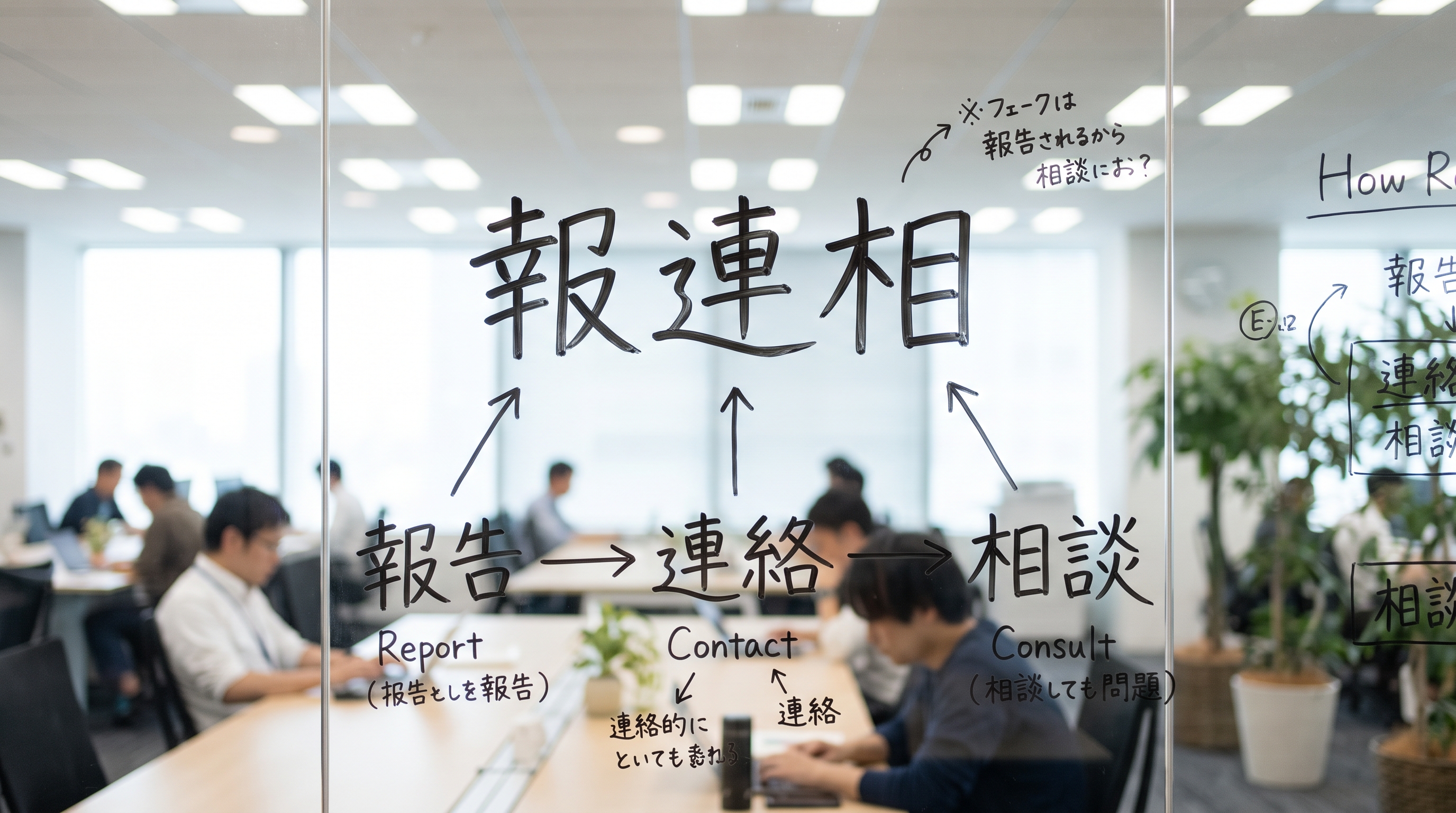
In a Japanese work environment, keigo is mandatory during choukai (朝会) and formal communication. This is not just about politeness -- it demonstrates professionalism and the ability to adapt to a Japanese workplace.
Example Houkoku (Daily Report) Pattern
Notice the use of ~ております (te orimasu) as the polite form, rather than ~ています (te imasu). In a Japanese business context, ~ております conveys humility (kenjougo, humble speech) which is the appropriate register when reporting on your own work.
This houkoku pattern is critically important because it is used every day during choukai. Memorize the structure, then swap in the content relevant to your work that day.
Japanese in Code Reviews
Code comments and pull request reviews are often written in Japanese. Here are examples of comments you will frequently encounter:
Being able to read and write comments like these will greatly improve your daily workflow. Start simple -- read your coworkers' comments, then gradually try writing your own.
Language-Based Soft Skills
Japanese at the office is not just about grammar and vocabulary. There are cultural aspects that are deeply tied to how you communicate:
- 空気を読む (kuuki wo yomu) -- reading the room. This skill is highly valued in Japanese workplaces. Understand when to speak, when to stay silent, and when to ask questions.
- 謙虚さ (kenkyo-sa) -- humility. Do not draw too much attention to yourself. Demonstrate your ability through your work output, not through words.
- The ability to apologize and learn from mistakes -- in Japan, sincerely acknowledging mistakes and showing corrective steps is valued more than making excuses.
- Reliability & consistency -- valued more than brilliance. Someone who can be counted on every day is more respected than someone who is brilliant but inconsistent.
Study Tips for Engineers Learning Japanese
Start now. Do not wait until you receive a job offer -- the language learning process takes years. Realistic targets: N3 as a minimum, N2 as the professional standard.
Recommended Tools
- Anki -- for kanji and vocabulary. Create a separate deck for IT technical terms
- NHK Web Easy -- news in simplified Japanese, great for reading practice
- Bunpro -- for grammar, with an SRS (Spaced Repetition System) approach
Engineer-Specific Strategies
- Study IT technical terms separately -- these are not in standard JLPT textbooks. Read Japanese tech blogs like Qiita and Zenn to get familiar with this terminology.
- Practice the houkoku pattern -- write a fictional daily report every day using the pattern discussed above
- Listen to Japanese tech podcasts -- to train your ear for natural speaking speed
- Everyday work language takes time -- even after passing N2, you will still need time to get used to real office language
Japanese Language and Your Career
Japanese language ability is not just about surviving at the office -- it directly impacts your career opportunities and visa status:
- JLPT N2 = +10 HSP visa points -- bonus points for the Highly Skilled Professional visa
- JLPT N1 = +15 HSP visa points -- with 70 points, you can qualify for the 1-3 year permanent residency fast track
- The more fluent your Japanese, the more doors open -- companies offering higher salaries often require strong Japanese ability
- Becoming a "bridge" between your home country and Japan -- this is a uniquely valuable strength that is highly sought after. Engineers who can bridge communication between international and Japanese teams command very high value in the job market.
Japanese is a long-term investment. Every kanji you memorize, every sentence pattern you master, will pay for itself many times over throughout your career in Japan.
Comments
0 comments